Ovulation spotting – how long does it last and when is there really nothing to worry about?

You noticed light spotting mid-cycle and immediately wondered: is this normal? Ovulation spotting can catch you off guard—especially the first time it happens. Sometimes it lasts a few hours, sometimes one day, and sometimes stretches to two. In this article you’ll find concrete numbers, clear distinctions, and tips on when you can rest easy and when it’s better to consult a doctor.
Ovulation spotting – how long does it last in a typical cycle?
Ovulation spotting usually lasts from a few hours to 1–2 days. It rarely extends to 3 days. And importantly—it has a scant character. It’s not a “mini period.” It’s more of a subtle, mid-cycle spotting that’s easy to miss. It often looks very inconspicuous. Sometimes you even wonder if it’s really blood.
Most often it looks like this:
- single streaks of blood on underwear,
- pink-brown mucus,
- no clots,
- no need to change pads frequently.
If you’re wondering how long ovulation spotting lasts, the answer in most cases is simple— most often one day. Sometimes it can gently “stretch” to two. It’s generally accepted that physiological periovulatory spotting should not exceed 2–3 days.
For comparison—menstruation is a completely different story:
- it usually lasts 3–7 days,
- it’s clearly heavier,
- it’s often accompanied by clots and PMS symptoms.
The difference is therefore noticeable. If spotting appears around the 12th–16th day of the cycle (in a classic 28-day cycle), is short and scant—in most cases it falls within normal limits. Of course, every cycle is a bit different. But these features— short duration and a small amount of blood —are key here.
Not sure how to tell spotting from changes in cervical mucus? Read our article on the types of cervical mucus during the menstrual cycle and see what the individual phases look like in practice.
How long can ovulation spotting last, and why does it appear at all?
Up to 2–3 days — if it lasts longer, that’s a sign it’s worth checking what’s going on. Not to worry you. Rather to give you clarity. But where does this spotting even come from? It all plays out at the hormonal level. Mid-cycle the body works very dynamically—sometimes even abruptly. At the moment the follicle ruptures:
- there is a short-term drop in estrogen,
- transient hormonal changes and slight irritation of blood vessels within the ovary or endometrium occur
- and there is an LH surge that precedes ovulation.
That’s really enough for slight spotting to appear. Minimal. Sometimes barely noticeable. It’s often accompanied by other ovulation symptoms—and those help piece the whole story together:
- one-sided lower abdominal ache,
- clear, stretchy mucus,
- increased libido,
- sometimes breast tenderness.
If you see several of these signals at once, it’s easier to understand that it’s simply the middle of the cycle. And one more thing—very important. Not every woman experiences ovulation spotting. For many, ovulation passes completely “quietly.” Lack of spotting does not mean lack of ovulation. It’s just one possible symptom.
Do you want to better recognize ovulation symptoms so you’re not relying solely on spotting? See the full list of signs and learn to combine them into a coherent picture of your cycle.
How many days does ovulation spotting last, and when is it no longer normal?
Most often 1 day. Up to 2–3 days max —and it should be clearly scant. It’s truly a short-lived episode, not prolonged bleeding. However, if something starts to deviate from this pattern, don’t ignore it. The body rarely “bleeds for no reason”. Sometimes it’s a minor hormonal imbalance, but sometimes a sign that it’s worth taking a closer look at your cycle.
It’s worth seeing a doctor when:
- the bleeding lasts more than 3–4 days,
- it becomes increasingly heavy,
- it appears at various times in the cycle,
- it is accompanied by severe pain, fever, or an unpleasant odor,
- you are over 40–45 and new, irregular bleeding appears.
Such symptoms go beyond physiological ovulatory spotting. And although the cause is often harmless, it’s better to rule it out definitively.
The following are not considered physiological:
- postcoital bleeding,
- intermenstrual bleeding at multiple points in the cycle,
- bright red, heavy blood with clots.
In such situations, the doctor usually starts with a thorough medical history and analysis of the cycle tracker—sometimes that alone helps identify certain patterns. The next step is often a transvaginal ultrasound, which assesses the endometrium and ovaries. Depending on the clinical picture, hormone tests (FSH, LH, estradiol, progesterone, TSH) are also ordered, and in some cases a Pap smear or colposcopy is performed to assess the cervix more closely. This is standard, structured diagnostics. No rush, but also without ignoring the signals your body is sending.
It is estimated that ovulatory spotting occurs only in some women and is not present in every cycle.
Ovulatory spotting and fertility – is it a good sign?
Ovulatory spotting itself does not reduce fertility, as long as it is not related to other health disorders. For some women, it can even be a signal: “this is the moment.” It appears mid-cycle and coincides with other ovulation symptoms—then it’s easy to connect the dots.
But it’s worth being cautious. Spotting is not a reliable indicator of fertile days. It may appear, but it may just as well not—even with normal ovulation. It is also often confused with other types of bleeding, such as:
- implantation bleeding (6–12 days after ovulation),
- bleeding related to hormonal contraception,
- bleeding resulting from causes such as polyps, fibroids, or endometriosis.
Therefore, if you’re trying to conceive, it’s better to rely on methods that provide a more objective picture of the cycle. The most common are:
- cervical mucus observation,
- LH tests,
- regular measurement of basal body temperature.
It is temperature that lets you see the so-called biphasic cycle curve. In the first part of the cycle, values are lower. After ovulation, under the influence of progesterone, there is a clear and sustained rise in temperature. This shift—rather than the spotting itself—confirms that ovulation actually occurred.
Wondering what ovulatory spotting means for your fertility and whether it’s a good sign when trying for a baby? Check out the detailed explanation and learn how to interpret this symptom in practice.
How to confirm ovulation when spotting occurs – the role of the MY OVU ovulation thermometer
Even if you experience brief, 1–2-day spotting, the most reliable way to confirm ovulation is objective temperature measurement. Symptoms are helpful, but data show what really happened in the cycle.
That’s why more and more women are turning to solutions that automate and simplify monitoring. Instead of guessing, you can simply look at the chart and check whether there was a characteristic temperature rise. It brings peace of mind—especially if you are trying to conceive or want to better understand your body.
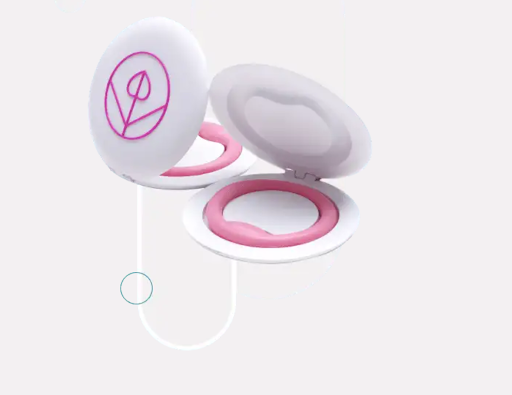
The MY OVU ovulation thermometer takes the form of an elastic ring made of medical-grade silicone that is placed in the vagina before sleep. At night, it automatically monitors basal body temperature with an accuracy of 0.01°C.
What does this mean in practice?
- You don’t have to remember to take your measurement at the same time in the morning.
- You don’t have to get up before your alarm.
- The device works while you sleep and stores data for up to 5 nights back.
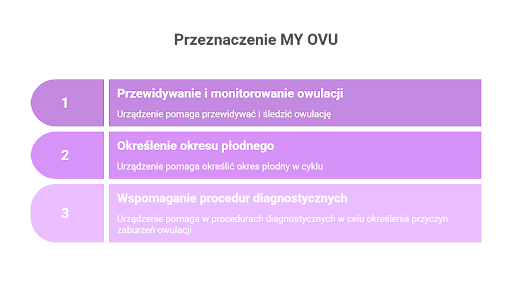
We know that taking your temperature every morning with a traditional thermometer can be hard. You have to remember to do it at a fixed time, not get up earlier, not change your sleep rhythm. MY OVU eliminates this problem because the measurement is taken automatically while you sleep at night. You sleep, the device measures.
If you’re looking for an answer to the question “how many days does ovulation spotting last,” remember: the duration of spotting is just a symptom. It’s the rise in temperature over the following days that indicates ovulation has occurred. And that’s what gives the greatest certainty.
Regular cycle monitoring helps you understand your body better, detect any irregularities sooner, and determine fertile days much more precisely. Over time you start to see recurring patterns, correlations, and small differences between cycles. And that gives you more than a one-off observation of spotting — real control over your cycle and greater peace of mind.
Ovulation spotting at a glance – key information
Ovulation spotting is most often a natural part of the cycle. It is brief and light, but its presentation should align with the timing of ovulation. The key is to distinguish what’s normal from situations that require follow-up. It’s estimated that ovulation spotting occurs only in some women and is not present in every cycle.
The most important takeaways from the entire text:
- it usually lasts from a few hours up to 1 day, a maximum of 2–3 days,
- it’s light — pink-brown mucus, single streaks, no clots,
- it most often appears around day 12–16 of the cycle (in a 28-day cycle),
- it may be accompanied by one-sided lower abdominal pain, fertile cervical mucus, increased libido, breast tenderness,
- lack of spotting does not mean lack of ovulation,
- menstruation lasts 3–7 days and is clearly heavier — it’s a completely different mechanism,
- concerning is bleeding that lasts more than 3–4 days, intensifies, or appears at different times in the cycle,
- alarming signs include severe pain, fever, unpleasant odor, bright red blood with clots,
- spotting alone is not a reliable indicator of fertile days — ovulation is confirmed only by a temperature rise.
If your cycle pattern is consistent and repeatable, there’s usually no need for concern. However, if something starts to deviate from your norm, it’s better to check it. And if you want certainty that ovulation truly occurred, regular temperature measurement gives the most objective answer and lets you gain real control over your cycle.