Ovulation pain and trying for a baby – when to have intercourse to truly increase your chances of getting pregnant?

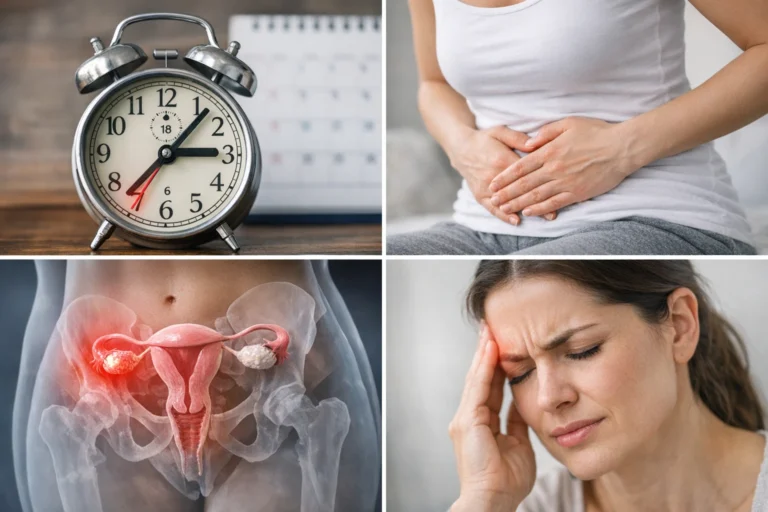
You feel a sudden stab on one side of your lower abdomen and immediately think: is it time? Is this ovulation? And most importantly – when should you have intercourse to avoid missing the best moment? This question comes up very often, especially when you really care about getting pregnant. Because on one hand your body is sending a signal, and on the other you’re not sure whether it’s the moment “now,” or maybe already a bit too late. If you’re trying for a baby, every clue matters. So it’s worth knowing exactly what mid-cycle pain means and how to smartly combine it with temperature tracking.
Ovulation pain vs. ovulation – is it really the moment?
Yes – it most often appears around ovulation – sometimes just before, during, or shortly after it. It’s estimated to affect as many as 20–40% of women of reproductive age.
What does it feel like? It varies. For one woman it’s a quick, sharp twinge. For another, a dull ache that lasts several hours, and sometimes even up to 48 hours. Most often it’s one-sided. Sometimes on the left, sometimes on the right. And that makes sense – ovulation may alternate between ovaries, though it’s not a rule. It’s a signal that the egg has just been released and is heading toward the fallopian tube.
In a typical 28-day cycle, this kind of pain appears around day 12–16, which is roughly 14 days before your period. And now the most important part. If you feel pain, ovulation is most likely near or happening right then.
It’s a very narrow window. The egg lives about 24 hours. Sperm – up to 5 days. That’s why waiting “until it hurts” to have intercourse can be a bit late. Especially if you want to maximize your chances.
Not sure if it’s ovulation yet? See the most common signs of ovulation and learn to recognize them in your cycle.
Ovulation pain – when to have intercourse? Before, during, or after the pain?
The highest chances of conception are 24–48 hours before ovulation and on ovulation day. That’s when your body is most ready. The egg is waiting. Time is on your side – but only briefly. In practice, you can simplify it to this pattern:
- intercourse 1–2 days before the expected pain,
- intercourse on the day ovulation pain appears,
- optionally the day after, if you feel ovulation has just finished.
Why does this matter? Because fertilization happens in the fallopian tube very soon after the egg is released. And sperm – although they can survive up to 5 days – still have to get there. It’s better for them to already be “waiting” than just starting their journey.
The statistics are quite clear. With intercourse at the optimal time, the chance of pregnancy in one cycle is about 20–30%. It may not sound like much, but timing can change everything. That’s why, when asking “when to have intercourse,” the answer is simple: rather before it hurts than only once the pain appears. Ideally when you see the first signs of fertility. Especially clear, stretchy cervical mucus.
Ovulation pain and conception – is it a good sign when trying to conceive?
Yes – ovulation pain often indicates that the cycle is ovulatory, which is crucial when trying for a baby. Without ovulation, conception isn’t possible.
If you regularly feel one-sided mid-cycle pain, it means your body is functioning properly.
But note – the pain alone doesn’t give full certainty about the exact timing of ovulation. It can happen that:
- ovulation is delayed despite the pain,
- the follicle doesn’t rupture (LUF),
- the pain is related to a cyst, not ovulation.
Therefore, when trying to conceive, it’s best to combine subjective symptoms with objective data. And this is where temperature comes in.
Wondering what temperature changes may indicate successful conception? Check out our article to learn what to look for after ovulation.
Ovulation pain and getting pregnant – why observation alone isn’t enough?
If you want to increase your chances of pregnancy, you need confirmation that ovulation actually occurred. And that’s indicated by a rise in basal body temperature of about 0.2–0.5°C after ovulation. That’s exactly why so many women combine pain observation with temperature measurements.
The MY OVU ovulation thermometer helps you:
- predict and monitor ovulation,
- identify the fertile window,
- support the diagnosis of ovulation disorders.
The device is an elastic ring made of medical-grade silicone, which is placed in the vagina overnight. It automatically measures basal body temperature with an accuracy of 0.01°C. You don’t have to wake up at a fixed time. You don’t have to remember a morning reading. MY OVU records data throughout the night and then syncs it with the app via Bluetooth.
Why is this so important in the context of ovulation pain? Because you can:
- check whether a temperature rise occurred after the pain,
- confirm that ovulation actually took place,
- predict future cycles based on charts.
Regular use allows you to identify the day of ovulation and monitor your cycle, which provides real support in planning intercourse. We understand that when you’re trying for a baby, you want certainty, not guesses. Combining body signals with temperature data gives a completely different level of control.
Do you want to know how to precisely identify fertile days using an ovulation thermometer and not rely solely on symptoms? Check out the practical step-by-step guide.
Key takeaways – how to use ovulation pain when trying to conceive?
Ovulation pain can be a valuable clue,but on its own it shouldn’t be the only determinant of when to have intercourse. The most important thing is understanding exactly when in your cycle this signal appearsand how to use it properly.
The most important things to remember:
- ovulation pain usually appears on the day of ovulation or just before it,
- the egg lives about 24 hours, and sperm can live up to 5 days,
- the highest chances of conception are 24–48 hours before ovulation and on the day of ovulation,
- a temperature rise of 0.2–0.5°C over the following days indicates that ovulation occurred,
- combining observations of cervical mucus, pain, and temperature increases the precision of planning intercourse.
If you want to get pregnant, the key is to get ahead of ovulation, not to react only when pain appears. Consciously combining body signals with temperature measurement – for example, using the MY OVU ovulation thermometer – lets you act more calmly and with greater confidence.