Short menstrual cycle – is a cycle under 25 days a warning sign?

If your cycle lasts 21, 22 or 24 days, you’re probably wondering: is that still normal? It’s easy to get lost online. Some say don’t worry. Others immediately scare you with hormones. The truth? As usual—somewhere in the middle. A short menstrual cycle doesn’t always mean illness. But sometimes it calls for attention. See when a cycle under 25 days is simply your physiology… and when it’s a signal to take a closer look at your health.
Is a short menstrual cycle under 25 days still within the normal range?
Yes—a 21–24 day cycle can be normal. It’s the lower limit, but still within the norm. With one condition: it’s regular and ovulatory.A cycle is considered normal if it lasts 21–35 days. We count from the first day of bleeding to the next period. Most often it’s 25–30 days. If your menstrual cycle is short—22 or 23 days—it’s not an alarm. It can still be your individual physiology.
What’s more concerning is:
- a cycle under 21 days,
- a sudden shortening by several days compared to previous months,
- shortening combined with severe pain or very heavy bleeding.
It’s estimated that shorter cycles (under 26 days) occur in some women, although cycles in the 25–30 day range are much more common. And here comes the key question. Not about the number of days, but something more important. Does ovulation occur in this cycle? Because it is the best indicator of your hormonal balance and fertility.
Do you want to better understand the stages of the menstrual cycle and their characteristics? Check out our article and find out exactly what happens in your body in each phase.
Short menstrual cycle 21–24 days – what’s happening with your hormones?
In most cases, a short cycle is due to a shortened follicular or luteal phase. Simply put—disruptions in the hormonal regulation of the cycle at the hypothalamus–pituitary–ovary axis level. The body is functioning, but the hormonal rhythm is accelerated or deregulated.
The most common causes include:
- progesterone deficiency (e.g., a shortened luteal phase),
- stress,
- excess body weight,
- excessive physical exertion,
- thyroid disorders,
- ovulation disorders (e.g., in the course of PCOS),
- uterine polyps.
These aren’t rare situations. Sometimes all it takes is a longer period of tension, intense work, sleep problems—and the cycle starts to shorten. The body reacts more quickly, ovulation appears earlier, or the post-ovulatory phase is too short.
For example: thyroid disorders often present with a short and heavy 22–23 day cycle. Chronic stress can shorten the luteal phase, which shortens the entire cycle. Meanwhile, with intensive training the body “saves energy,” which also affects cycle length.
In teenagers, a shortened cycle can be temporary—the hormonal balance is still stabilizing. During perimenopause, it’s also a common stage of hormonal changes and ovarian function decline.
But if you have a very short menstrual cycle under 21 days that persists for several months in a row, that’s a sign to check what’s going on. In such a case, it’s worth doing hormonal tests and an ultrasound (USG)—not to worry, but to have clarity.
Wondering what anovulatory cycles are and whether they might apply to you? See our article to learn how to recognize them and when they require diagnostics.
A too-short menstrual cycle and fertility – is it harder to get pregnant?
Yes—a short 21-day menstrual cycle can shorten the fertile window. In such cases, ovulation may occur earlier, which shortens the follicular phase, and the luteal phase (the time after ovulation) may not provide an adequate progesterone level.
Data indicate that:
– in some cases, short cycles may be associated with ovulation disorders or a shortened luteal phase,
– they can make it harder to conceive if the luteal phase is insufficient,
– more frequent and/or heavy bleeding may increase the risk of iron deficiency.
So if you have a short menstrual cycle and are trying to conceive, the key is to confirm whether ovulation actually occurs. And here’s a practical aspect that—we know—is a game-changer for many women: monitoring basal body temperature.
How to check if ovulation occurs with a short cycle? The role of the MY OVU thermometer
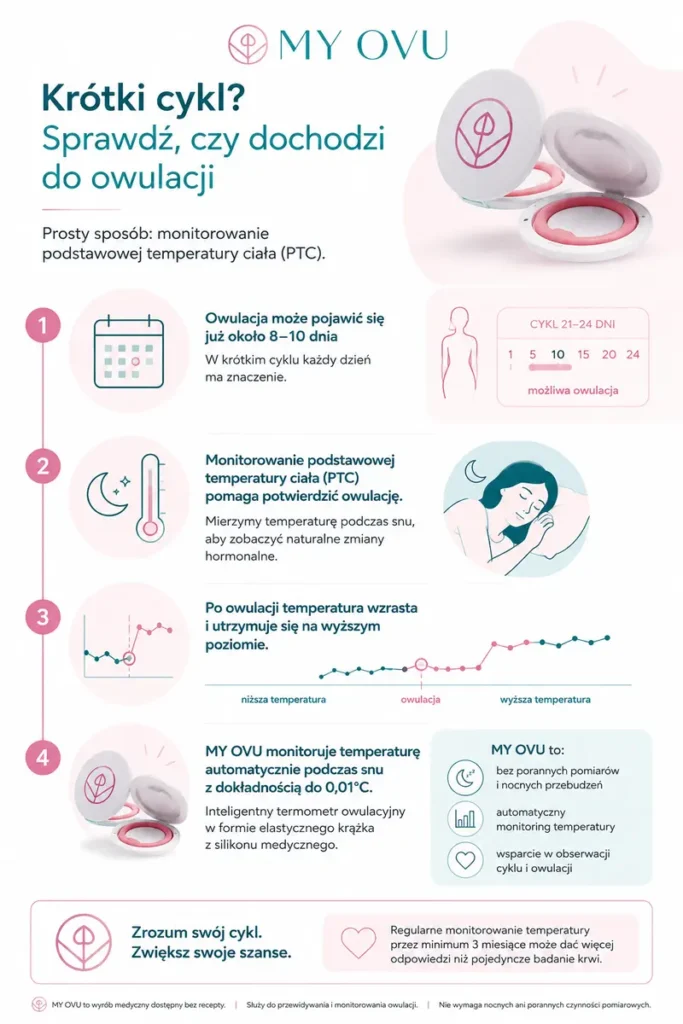
The simplest way: measure your basal body temperature (BBT) and observe its rise after ovulation. Classic thermometers require daily morning measurements at the same time. With a short cycle it’s easy to miss something—ovulation can occur as early as days 8–10.
The MY OVU ovulation thermometer works differently. It’s a flexible ring made of medical-grade silicone that is placed in the vagina before sleep. At night:
- it automatically monitors temperature,
- it records data with an accuracy of 0.01°C,
- it does not require any nighttime or morning measurement actions.
This is especially important with a short menstrual cycle, where every day matters.
Regular use of MY OVU helps identify the day of ovulation and confirm whether the cycle is ovulatory. The device is an over-the-counter medical product and is used for:
- predicting and monitoring ovulation,
- determining the fertile window,
- supporting the diagnosis of ovulation disorders.
If you’re wondering whether a short menstrual cycle is just a matter of stress or a real hormonal issue, 3 months of temperature monitoring can provide more answers than a single blood test.
Not sure how to measure your basal body temperature to confirm ovulation? Read our guide and follow a simple step-by-step instruction.
When should a short menstrual cycle prompt you to see a doctor?
There are times when observation alone isn’t enough. If something repeats every month and starts to worry you, it’s better to check it. The body usually sends signals. You just have to not ignore them.
It’s worth consulting a specialist when:
- the cycle shorter than 21 days persists for more than 3 months,
- it’s accompanied by very heavy bleeding,
- there is severe pain,
- you’re planning a pregnancy and conception isn’t happening.
Diagnostics usually aren’t complicated. And they can provide a lot of answers. They most often include:
- ultrasound,
- testing FSH, LH, estradiol, and progesterone,
- thyroid examination.
Treatment depends on the cause. Sometimes it’s enough to get the basics in order— less stress, stable body weight, moderate activity. Seemingly simple things, yet they can change a lot. In other situations, pharmacotherapy is needed. And that’s okay too—if the body needs support.
The most important thing is this: a short cycle is not a sentence. If it is ovulatory, regular, and not accompanied by concerning symptoms, it may simply be your normal.
And if something raises doubts, conscious monitoring gives you a sense of control. For example, with the help of the MY OVU ovulation thermometer. Then you can clearly see what’s happening in your body. Because one thing is certain—the greatest peace comes from knowledge.
Summary – key information about a short menstrual cycle
A short menstrual cycle under 21 days doesn’t always indicate a health problem. What matters most is whether it’s regular, ovulatory, and not accompanied by concerning symptoms.
Main points in brief:
- a 21–24-day cycle may fall within the lower limit of normal,
- a cycle under 21 days that persists for several months requires diagnostics,
- the presence of ovulation is more important than the number of days itself,
- a shortened cycle may result from stress, hormonal imbalances, thyroid problems, or ovulation disorders,
- when trying to conceive, it’s worth confirming ovulation, e.g., by tracking temperature or via ultrasound monitoring.
If your cycle is shorter but stable and ovulatory, it may be your natural physiology. And if something is worrying, mindful observation and a medical consultation help you regain peace of mind and real control over your health.