How does it work?
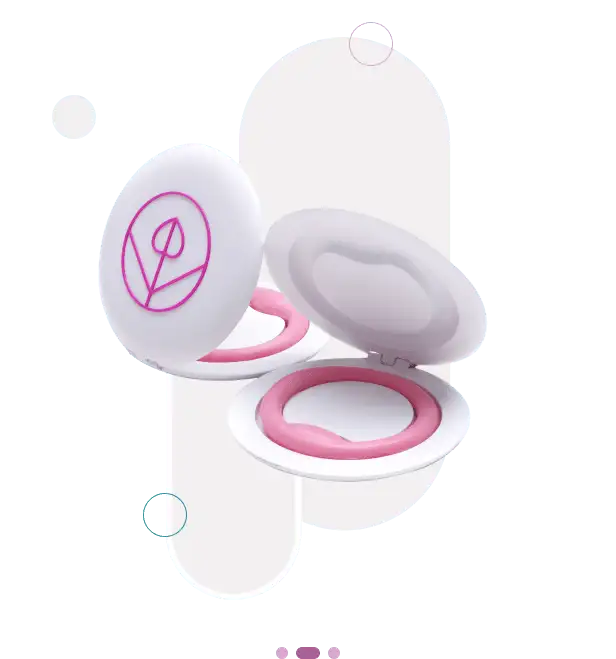
MY OVU is a home cycle monitoring system that uses nightly, continuous body temperature measurement and data analysis in the app.
Accurate data. Automatic measurement. No morning routine.
Apply
Insert MY OVU into your vagina before going to sleep. The easiest way to do this is to bend the ring inward at the thickened part.
Fall asleep
MY OVU collects data while you sleep.
Sync
In the morning, remove the disc and wash it with soap. Turn on Bluetooth and send the data to your phone—just press the button on the thickened part of the disc.
Why is taking a temperature at night more accurate?
The classic basal body temperature method requires taking a measurement every morning at the same time, before getting out of bed and before engaging in any activity. In practice, this is tedious, prone to disruption, and subject to error. A single morning measurement can be distorted by waking up later, movement, shorter sleep, ambient temperature, or simply skipping the measurement. MY OVU eliminates this problem because it measures temperature at night, multiple times and automatically, allowing the app to better filter out disturbances and determine your actual basal body temperature.
That is why continuous nighttime monitoring provides greater accuracy than:
Continuous monitoring provides more reliable data than a single reading in the morning.
Cycle analysis in the application
The data is analyzed automatically—without the need to manually interpret the charts.


Comparison of menstrual cycle monitoring methods
 |
Calendar (app) |
Ultrasound monitoring |
LH tests |
|
|---|---|---|---|---|
|
What is it all about? |
Continuous overnight measurement of core body temperature + analysis in the app based on physiological data |
Predicting ovulation based on cycle length and statistics |
Monitoring follicle growth in a doctor’s office |
Detecting the LH surge in urine before ovulation |
|
Precision |
High – based on real-time body data, multiple measurements throughout the night, fewer disturbances |
Low – relies on assumptions, not on actual signals from the body |
Very high (on a scale of 1 to 10) |
Average – indicates the hormonal peak, not always actual ovulation |
|
Comfort |
Very high – works automatically while you sleep, without a daily routine |
High – easy to use, fast |
Low – requires visits, time, and organization |
Average – requires regular testing (often twice a day) |
|
Limitations |
Requires a device |
Does not confirm ovulation; high risk of error with irregular cycles |
Expensive, shows only a small part of the cycle, lacks continuity of observation |
Easy to miss, difficult to interpret with irregular cycles |