How to accurately determine fertile days? The role of an ovulation thermometer
Fertile days are a key moment in a woman’s menstrual cycle, determining the highest chance of getting pregnant. Although in theory ovulation occurs in the middle of the cycle, in practice its timing can vary depending on many factors, such as stress, diet, physical activity, or natural hormonal fluctuations. Accurately identifying fertile days not only increases the chances of pregnancy but also helps to detect potential cycle disorders early. One of the most accurate tools for tracking fertility is the ovulation thermometer and the basal body temperature (BBT) method.
Why is it worth tracking fertile days?
Identifying fertile days is extremely important both for women trying to conceive and for those who want to better understand their menstrual cycle. With systematic cycle observation, you can:
- Pinpoint the moment of ovulation and increase the chances of conception.
- Monitor hormonal health – irregular temperature patterns may indicate anovulatory cycles, progesterone issues, or other disorders.
- Plan intercourse – having sex during the fertile window increases the likelihood of conception.
- Use natural contraception – knowing your cycle allows you to avoid peak fertility days for contraceptive purposes.
Many women rely on popular cycle-tracking apps that predict ovulation based on average cycle length. However, such forecasts are not accurate enough. The only reliable method is observing changes in your body, and one of the best ways to detect them is to regularly measure your temperature with an ovulation thermometer.
What is an ovulation thermometer and how does it work?
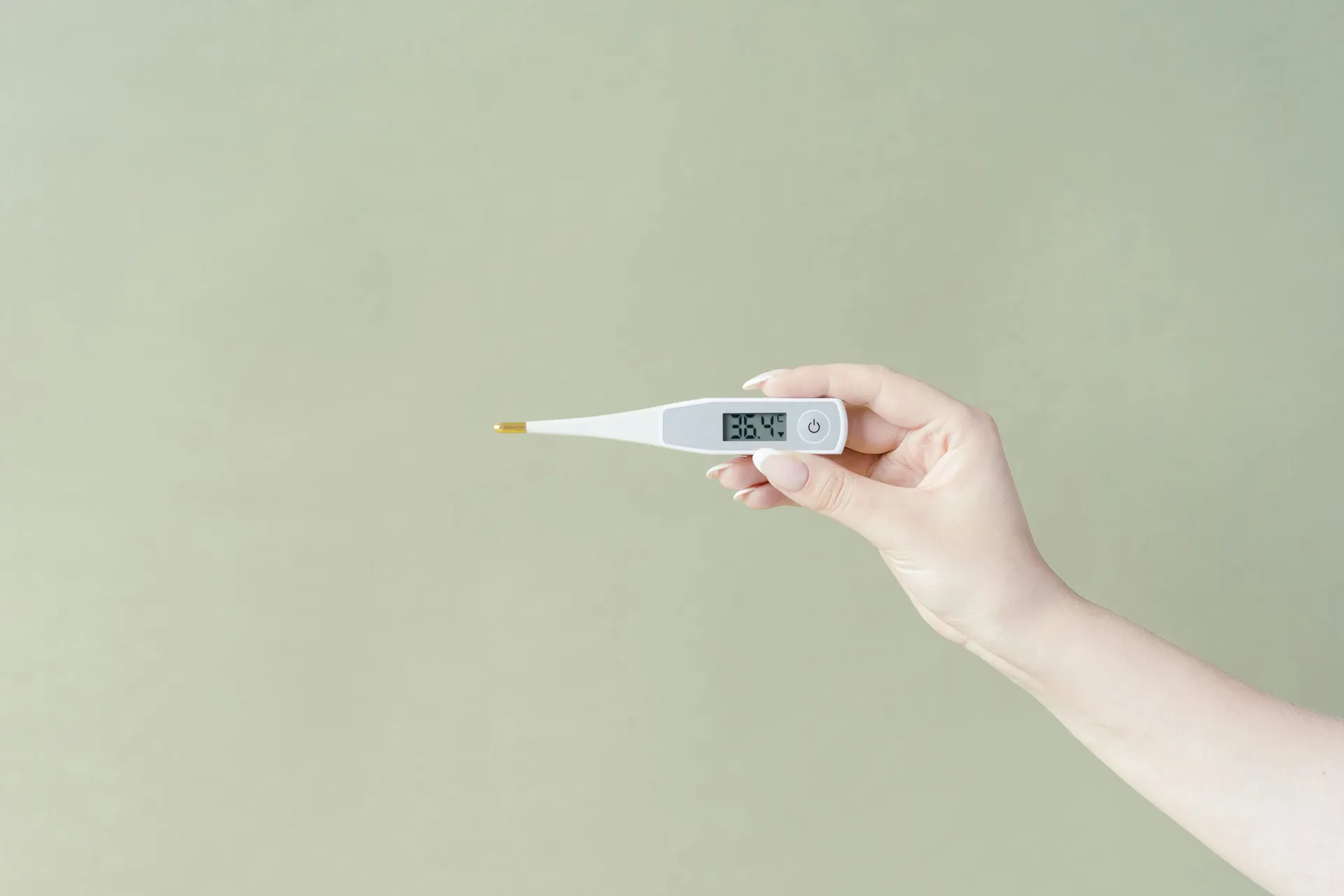
An ovulation thermometer is a specialized device used to precisely measure basal body temperature (BBT). Unlike regular thermometers, it features higher accuracy (to two decimal places), which allows you to notice subtle temperature changes associated with ovulation.
The BBT method involves measuring your temperature every day right after waking up, before doing any activity. Temperature changes throughout the cycle in characteristic ways:
- Follicular phase (before ovulation) – temperature is lower and usually ranges from 36.1–36.5°C.
- Ovulation – on ovulation day there is often a brief drop in temperature, followed by a rise of 0.2–0.6°C within 24–48 hours.
- Luteal phase (after ovulation) – temperature remains at a higher level (approx. 36.7–37.1°C) until the end of the cycle.
If after ovulation the temperature stays elevated for at least 14 days, this may be the first sign of pregnancy. Conversely, a lack of temperature rise may indicate an anovulatory cycle, which may be caused by hormonal issues.
How to correctly measure ovulation temperature?
For the BBT method to be effective, follow a few important rules:
- Measure your temperature at the same time every day, right after waking up, before any activity.
- Always use the same ovulation thermometer to avoid measurement discrepancies.
- Measure in one location – ideally vaginally, orally (under the tongue), or rectally. Underarm measurements are not recommended because they can be less accurate.
- Record your results – you can chart them manually or use apps that support fertility tracking.
- Watch for external factors – illness, stress, alcohol consumption, or irregular sleep can affect the reading.
How to interpret the temperature chart?
To correctly interpret temperature changes, it’s worth keeping a BBT chart for several months. Here are the key indicators:
✔ Ovulation – confirmed if there’s a clear temperature rise that lasts for at least 3 consecutive days.
✔ No ovulation – if the temperature chart does not show a characteristic mid-cycle rise.
✔ Possible pregnancy – if the temperature remains elevated for more than 14 days after ovulation.
It’s worth noting that temperature alone does not predict ovulation; it only confirms that it has already occurred. Therefore, the BBT method works best when combined with other cycle observation methods, such as cervical mucus analysis.
What can affect measurement accuracy?
Although the BBT method is very effective, certain factors can influence measurement results. These include:
- Irregular sleep or changes in sleep hours
- Alcohol or caffeine consumption before sleep
- Intense stress
- Illnesses and infections, especially those with fever
- Incorrect measurement method (e.g., changing the place where the temperature is measured)
Summary: Why is it worth using an ovulation thermometer?
If you’re planning a pregnancy or want to better understand your body, an ovulation thermometer is one of the best tools for tracking fertility. Regular temperature measurement helps determine the exact moment of ovulation, detect cycle irregularities, and spot the first signs of pregnancy early.
The basal body temperature method is a natural, safe, and effective way to support fertility. It’s worth combining it with other cycle-tracking methods, such as cervical mucus analysis or ovulation tests, to obtain even more accurate results.