Stages of the menstrual cycle and their characteristic features

What does the menstrual cycle look like in women?
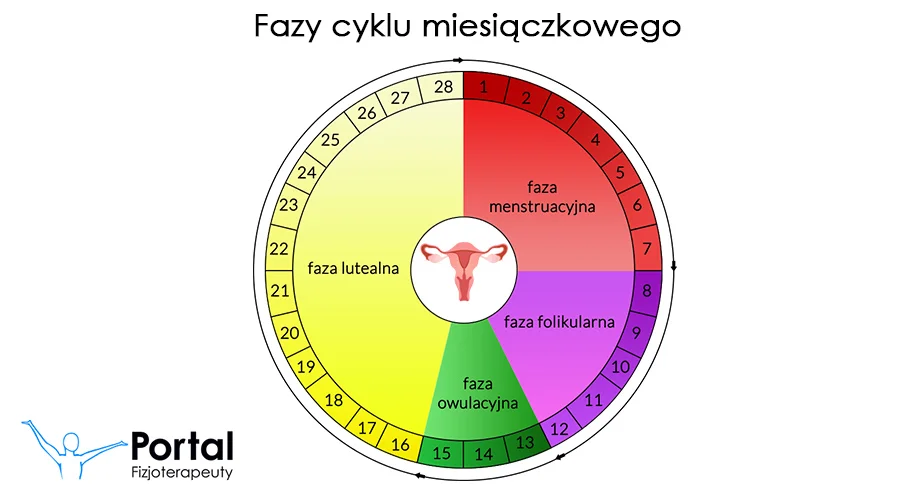
From the first period until menopause, our bodies function in menstrual cycles that consist of three successive phases:
- follicular phase,
- ovulation,
- luteal phase.
Let’s take a look at what happens in our bodies during each of these phases.
Source: Portal Fizjoterapeuty
Follicular phase
The follicular phase, also called the proliferative phase, begins with menstruation, which is the shedding of the uterine lining (endometrium). Bleeding usually lasts from three to five days and may be accompanied by symptoms such as painful lower abdominal cramps, headaches, fatigue, sleepiness, mood swings, nausea, and diarrhea. In the following days of this phase, estrogen production increases, stimulating the regrowth of the endometrium. At the same time, ovarian follicles mature and develop under the influence of follicle-stimulating hormone (FSH). After a few days, one of the ovarian follicles becomes dominant and halts the development of the others, becoming the Graafian follicle.
Ovulation
Ovulation is a key stage of the menstrual cycle, essential for female fertility. When the egg cell (oocyte) is mature, the Graafian follicle ruptures, releasing it. The egg enters the fallopian tube, where it matures and waits to be fertilized by a sperm cell. If fertilization does not occur, the egg dies after about 24 hours.
Luteal phase
The luteal phase begins after ovulation. During this time, the woman’s body prepares for the implantation of the egg in the uterus. The remnants of the Graafian follicle transform into the corpus luteum, which produces progesterone and estrogen necessary for embryo implantation and maintaining pregnancy. If fertilization does not occur, the corpus luteum regresses, and the uterine lining begins to shed, leading to the next menstrual bleed. If a woman produces insufficient amounts of progesterone or the luteal phase lasts less than 10 days, luteal phase deficiency may occur.
Luteal phase deficiency means difficulty maintaining the embryo within the uterine wall in the first days after fertilization. Diagnosing this issue requires long-term cycle observation. It is a common cause of reduced fertility in women trying to conceive at a later age. The American Society for Reproductive Medicine has recognized basal body temperature tracking as a primary diagnostic tool for this disorder.
When does ovulation occur?
If the menstrual cycle runs without disruptions, ovulation should occur 13–15 days before the next bleed, in a 28-day cycle. In practice, however, cycles can be irregular. Factors such as stress, sleep problems, weight loss, climate changes, travel, and hormonal disorders can affect cycle regularity. That’s why it’s important to know your body and monitor your cycle.
How to recognize ovulation?
Ovulation can be recognized by several characteristic symptoms:
- Changing cervical mucus: before ovulation it is tacky and sticky, and during ovulation it resembles raw egg white—it is thicker, more stretchy, and clear.
- Ovulation pain: lower abdominal pain on one side, depending on which ovary released the egg.
- Breast tenderness and soreness.
- Increased libido.
- General fatigue and weariness.
- Elevated body temperature.
- Acne flare-ups.
How long does ovulation last?
The ovulation process itself lasts up to 48 hours, and the egg is capable of being fertilized for about 12 hours. However, sperm can survive in the female reproductive tract for up to 72 hours, so the fertile window spans about 5–6 days—two days before and one to two days after ovulation. For women using natural contraception methods, it’s important to remember that intercourse a few days before ovulation can result in fertilization.
Knowing your menstrual cycle and being able to recognize fertile days are crucial for family planning and reproductive health. Observing cervical mucus and basal body temperature can help you better understand your body and menstrual cycle. Regular monitoring allows for early detection of potential disorders and effective family planning.