
Home › About us › For clinics
MDR CE certification in progress · Class IIa · Clinic partnerships
Your patient comes back with data, not guesswork.
She measures her deep body temperature at home, in her sleep, night after night. At her next appointment she brings a structured picture of her cycle. Your clinic gains data from the time between appointments that it had no way of getting before.
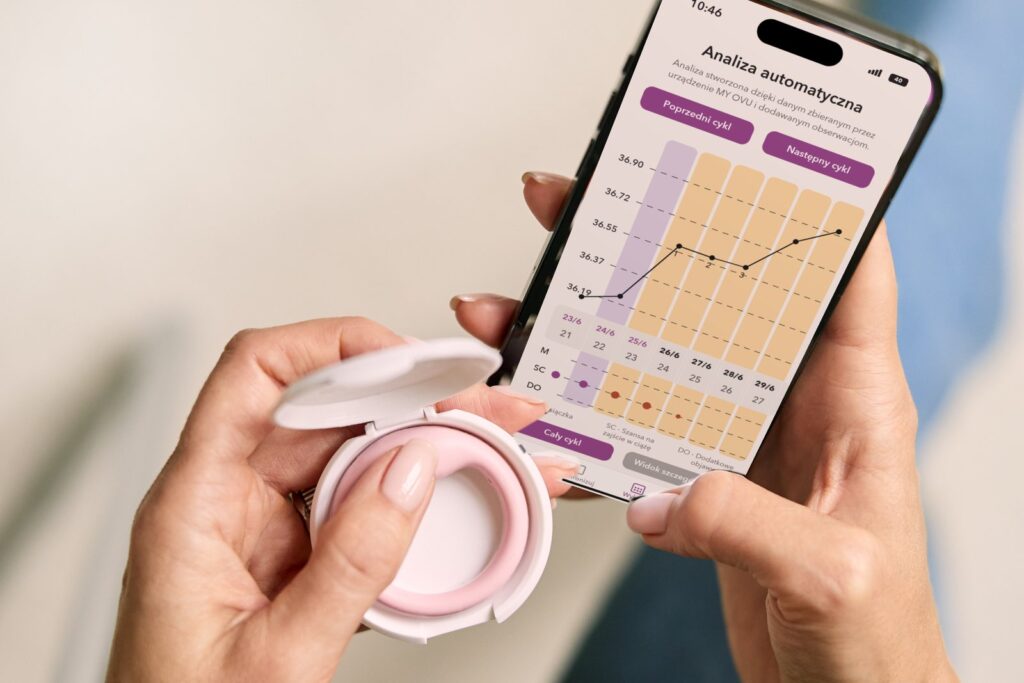
Illustrative MY OVU app screen

Partner clinic in Poland
Aurea Med, Warsaw.
Together we are shaping a patient pathway in which at-home cycle measurement supports the clinic appointment.
Clinic enquiries
Let’s talk about working with your clinic.
Tell us about your practice in a couple of sentences. We’ll come back to you with specifics.
- We reply within 2 working days.
- Terms are agreed case by case, depending on the size and profile of your practice.
- Prefer email? office@my-ovu.com
Send enquiry
We process the details from this form only to contact you. See our privacy policy for more.
Working together
How it works in day-to-day practice
Three steps. No extra work for reception.
1
Clinic
The clinic adds MY OVU to the patient pathway.
The patient receives a sensor and a 3-month app subscription as part of observing her cycle at home.
2
Home
The patient measures in her sleep.
The sensor records deep body temperature night after night, and the app builds a picture of the cycle from the readings. There is no morning routine, so no gaps in the data from missed mornings.
3
Appointment
The cycle picture comes back to the clinic.
At the next appointment, the clinician sees the temperature curve and cycle patterns for the whole period between visits. After three months, the patient can carry on by herself.
The gap between appointments
Today that period is a blind spot. History-taking relies on the patient’s memory, basal body temperature (BBT) charts come back incomplete, and calendar apps identify the day of ovulation correctly in no more than 21% of cases (Johnson et al., 2018), while only 7.5% of the apps and websites reviewed gave the correct fertile window for a model cycle (Setton et al., 2016). Ultrasound monitoring provides the detail, at the cost of appointments, time and availability. MY OVU does not replace any of these methods. It fills the gap between them.
Data that wasn’t there before
A continuous picture of the cycle between appointments.
A more engaged patient
She sees her own data, so her questions are more specific.
Positioning your practice
A European Class IIa device, with MDR CE certification in progress, shows that your practice works from data.
Same night: deep body temperature and skin temperature
- Deep body temperature (MY OVU sensor)
- Skin temperature (wristband)
Credentials you can check
Who is behind it.
The development of MY OVU is advised by a Medical and Scientific Board. The team’s work was presented and recognised at the ISGE congress in Florence in 2024. You’ll find the board members, references and publications on their own pages, in full and without marketing paraphrase.
Class IIa
MDR CE certification in progress
Deep, not skin-level
internal measurement, all night
ISGE 2024
Forbes Women 2026
Polish Femtech Startups
Medical and Scientific Board → · Scientific references → · Press room →
Want to talk about working together?
Leave your details and we’ll come back to you with specifics.
MY OVU supports cycle observation and does not replace medical advice. The device is undergoing MDR CE certification.