Can you rely on cycle-tracking apps?
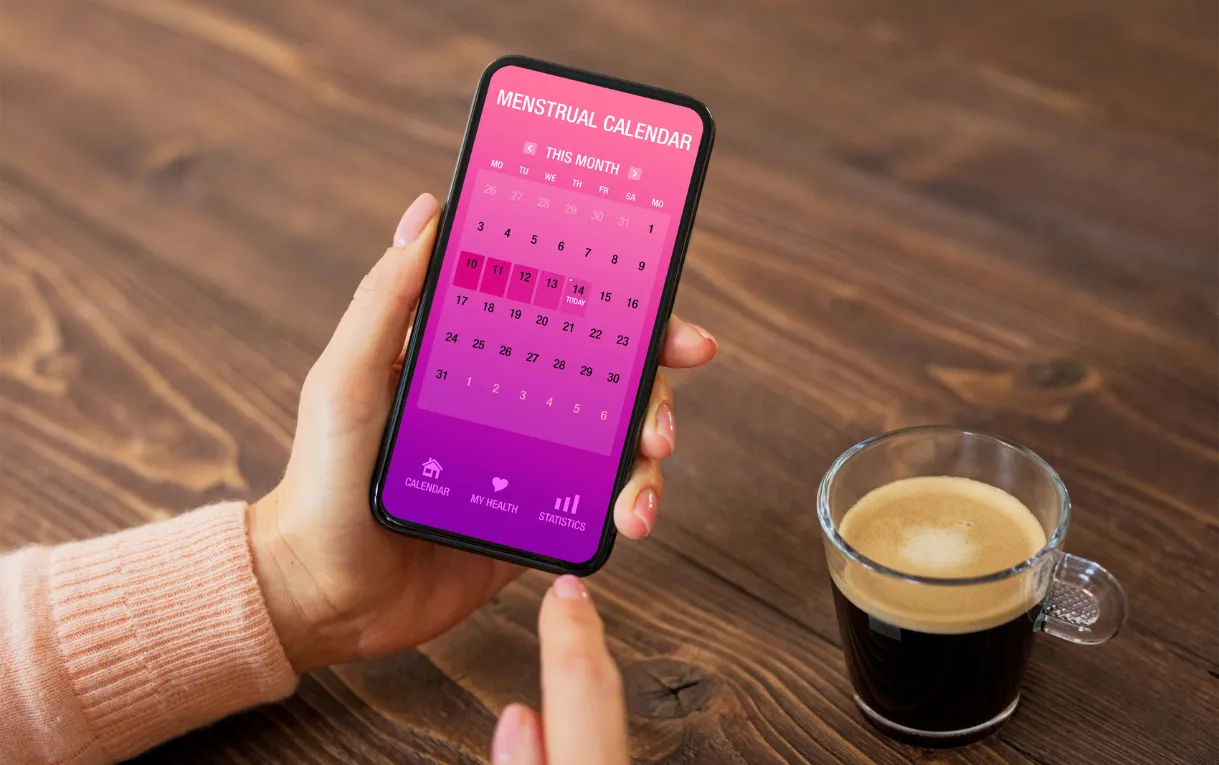
In recent years, among women planning pregnancy, we’ve witnessed a real explosion in the popularity of cycle-tracking apps. They’re colorful, free, offer handy reminders, and even integrate with watches and fitness trackers. Sounds like the perfect support? Unfortunately, many of these tools run on simplified schemes and can do more harm than good.
At first glance, they seem helpful: you enter the date of your last period, choose your cycle length (most often automatically suggested as 28 days), and you get a calendar with “ovulation” marked. The problem is that most women don’t have a perfectly 28-day cycle, and ovulation doesn’t always occur on day 14. Relying on such assumptions can lead to poor decisions, and even unnecessary frustration and stress when repeated attempts to conceive are unsuccessful.
Scientific data versus app assumptions
In a groundbreaking study published in Current Medical Research and Opinion, researchers analyzed the cycles of as many as 949 women. Participants provided daily urine samples to measure the LH hormone, whose surge heralds ovulation. This made it possible to very precisely determine when ovulation actually occurred.
The results were surprising:
“The average cycle length was 28 days, but only 15% of women actually had a cycle of that length, even though as many as 34% believed their cycle lasted 28 days.”
Johnson S., Marriott L., Zinaman M. (2018)
This means that over 80% of women misjudge the length of their cycle—and apps that base their calculations only on these data rely on false assumptions.
Even more concerning are the findings on the exact day of ovulation. For women with a 28-day cycle, it most often occurred on day 16, but the distribution was very broad:
“The probability of ovulation ranged from day 11 all the way to day 20.”
Johnson S., Marriott L., Zinaman M. (2018)
In other words, even a woman with an “ideal” 28-day cycle can ovulate within a window of up to 10 days—no app can accurately predict this if it relies solely on a calendar.
Why calendars fail
Most apps on the market don’t disclose how they calculate ovulation day or what clinical experience they have. The study identified 73 popular apps—none revealed their algorithm, and only one provided any accuracy claim (60%). And that was under simulated conditions.
In practice, most apps assume ovulation occurs on day 14 in a 28-day cycle. Meanwhile, the probability that a woman actually ovulates on that day is just 14%. For day 15 it’s 19%, and the highest chance is on day 16 (21%). That’s still far too little to plan intercourse or assume fertile days based on it.
It’s like trying to guess a random number on a die—you’ve got less than a 1 in 5 chance the app will show you the correct day.
Apps alone aren’t enough
While apps can be an attractive complement, they are not a standalone diagnostic tool. To have real value, they need precise, daily biological data. Without that, they’re just a digital calendar based on guesswork.
That’s why the best results come from apps integrated with technologies that actually monitor changes in the body—for example, a vaginal ovulation thermometer. This small device is used overnight and automatically records resting basal body temperature (BBT). The measurement happens without the user’s involvement—accurately, at the same time every night, without errors related to manual readings. The data are sent to the app, and the algorithm analyzes them in real time, creating an individual cycle profile.
What works better? Observation and technology combined
Knowing that every woman’s cycle is different and ovulation can vary between cycles, the only effective solution is daily, consistent observation of biological indicators. The best and most reliable of these is body temperature measured at rest—the so-called basal temperature.
But there’s a hurdle here too: who measures their temperature every day, at the same time, before getting out of bed, and logs the data? Any shift in sleep time, stress, infection, or a sleepless night can distort the result.
That’s why the ideal solution is a vaginal ovulation thermometer that records body temperature without your involvement—at night, while you sleep. This ensures precise measurements, and the data go directly to the app, which analyzes your cycle based on them.
Technology tailored to you, not the other way around
Unlike calendar apps that assume in advance “what should happen,” this solution observes what is actually happening in your body. With each subsequent cycle, the algorithms learn your rhythm, and you gain confidence that the information is tailored to you—not to a textbook model woman.
You no longer have to wonder whether the app guessed right or got it wrong again. No more guessing. You have concrete data you can use to plan pregnancy, monitor hormonal health, or simply understand your body better.
In a world where there’s an app for everything at your fingertips, it’s easy to get lost. But your health and fertility can’t be based on averages and statistics. This is your body—and it deserves precision.
Scientific source:
Johnson S., Marriott L., Zinaman M. (2018). Can apps and calendar methods predict ovulation with accuracy? Current Medical Research and Opinion, 34:9, 1587–1594. DOI: https://doi.org/10.1080/03007995.2018.1475348