Blocked fallopian tubes – symptoms, causes, and real chances of getting pregnant

If you’re trying for a baby and, despite regular cycles, pregnancy isn’t happening, one question starts to arise: is everything okay with me? One of the more common and at the same time most insidious causes of difficulty conceiving is blocked fallopian tubes. Importantly, they very often don’t produce any clear symptoms. In this article, you’ll find concrete information: what fallopian tube obstruction is, what causes it, how diagnosis looks, and when pregnancy is realistically possible—naturally or via in vitro.
What are blocked fallopian tubes and why do they hinder pregnancy?
Blocked fallopian tubes are a situation in which the lumen of the tube is partially or completely closed. This means one thing— the egg cannot meet the sperm or the fertilized embryo cannot reach the uterus.
Many people imagine a fallopian tube as a simple pipe. That’s not quite how it works. It’s a living, active structure. It has ciliated epithelium, makes small movements, and “helps” the egg move along. And importantly— even if a tube appears patent on testing, its function may be impaired. And that alone is enough to reduce fertility.
The statistics are clear. The tubal factor accounts for about 20–35% of female causes of infertility, and in some analyses even 30–40%. That’s a really large share of cases.
Several situations are distinguished:
- unilateral obstruction – one tube works, the other doesn’t,
- bilateral obstruction – both are closed,
- partial obstruction – pregnancy is possible, but the risk of ectopic pregnancy increases,
- hydrosalpinx – a tube filled with fluid, which can reduce the effectiveness of in vitro by even around 50%.
And that’s exactly why the topic of “blocked tubes and pregnancy” doesn’t have a single simple answer. It all depends on which tube is affected, to what extent, and whether the problem involves one or both. Each scenario means something slightly different.
Do blocked fallopian tubes cause symptoms?
In most cases, blocked fallopian tubes don’t produce characteristic symptoms. This is one of the hardest facts to accept. You can have regular cycles, normal ovulation, and no pain — and yet tubal patency may still be impaired.
If symptoms do appear, they usually result not from the obstruction itself but from its cause. These may include:
- chronic lower abdominal pain,
- painful periods,
- pain during intercourse,
- recurrent pelvic organ infections,
- a history of pelvic inflammatory disease.
Many women start to suspect a problem only when after 12 months of regular trying (or 6 months after age 35) pregnancy still doesn’t occur. And here’s an important point. If you’re tracking your cycle, measuring your temperature, you see a clear rise after ovulation, and yet pregnancy isn’t happening— it’s worth considering a tubal patency workup.
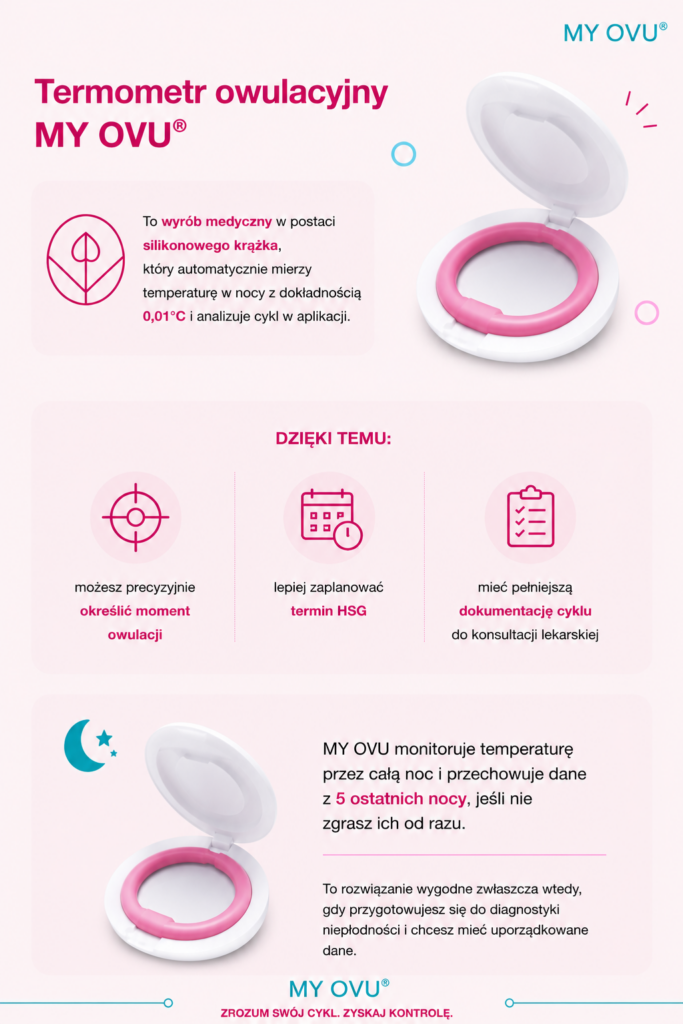
Devices such as the ovulation thermometer MY OVU help you very accurately monitor basal body temperature (with 0.01°C resolution), automatically during sleep. This provides reliable information on whether ovulation is truly occurring.

But—and this is very important— MY OVU does not assess fallopian tube patency. It can confirm that a cycle is ovulatory, but it won’t answer whether the egg has a clear path to the uterus.
What are the causes of blocked fallopian tubes that most often underlie the problem?
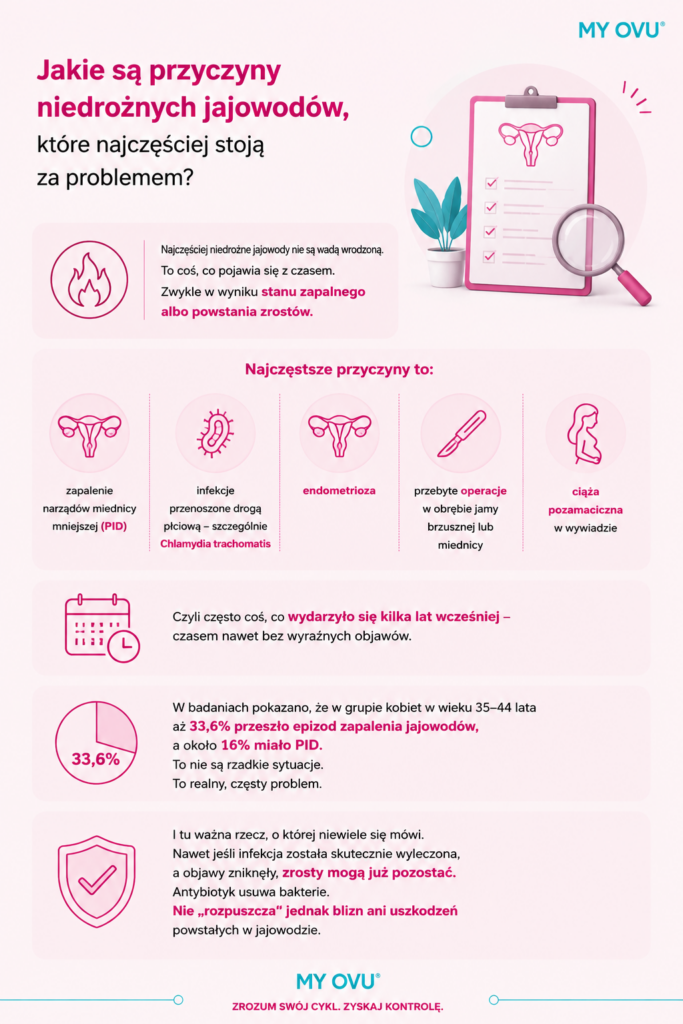
Most often, blocked fallopian tubes are not a congenital defect. It’s something that develops over time, usually due to inflammation or the formation of adhesions.
The most common causes are:
- pelvic inflammatory disease (PID),
- sexually transmitted infections—especially Chlamydia trachomatis,
- endometriosis,
- past surgeries within the abdominal cavity or pelvis,
- history of ectopic pregnancy.
So often something that happened a few years earlier— sometimes even without clear symptoms.
Studies show that in the group of women aged 35–44, as many as 33.6% had an episode of salpingitis, and about 16% had PID. These are not rare situations. This is a real, common problem.
And here’s an important point that rarely gets mentioned. Even if the infection was successfully treated and the symptoms disappeared, adhesions may already remain. An antibiotic eliminates bacteria. However, it does not “dissolve” scars or damage that formed in the fallopian tube.
That’s why sometimes a woman hears, “infection cured,” yet the patency of the fallopian tubes does not return to normal. And that’s exactly why proper diagnostics are so important when pregnancy doesn’t occur despite regular attempts.
Wondering if tubal blockage is the only possible cause? Check the most common causes of difficulty conceiving and see where the tubal factor fits into all of this.
Blocked fallopian tubes and pregnancy – is natural conception possible?
With one blocked fallopian tube, natural pregnancy is possible. With both blocked — most often not. If one tube functions properly, the egg still has a chance to meet the sperm. That’s good news. But it’s not the only factor that matters.
Real chances are also influenced by:
- age,
- ovarian reserve,
- partner’s semen quality,
- other conditions, for example endometriosis.
So the mere fact that one tube is open doesn’t yet give the full picture. The whole context matters.
The situation is different with bilateral blockage. Then — to put it plainly — the egg has no way to reach the sperm. Physically there’s no pathway. In such cases, a doctor may suggest:
- surgical treatment,
- recanalization of the proximal segment of the tube,
- in vitro procedures.
This is a decision made individually. Always after thorough diagnostics.
It’s also worth knowing that partial blockage carries additional risk. It increases the likelihood of ectopic pregnancy. After an ectopic pregnancy, the statistics are clear. About 52% of women later conceive an intrauterine pregnancy, but the risk of another ectopic pregnancy is about 12.6%. This shows that the history of the fallopian tubes has long-term implications. That’s why with blockage, an individual approach and a calm discussion of all scenarios are so important.
Blocked fallopian tubes are just one possible factor. Check what can cause infertility and see which elements are worth analyzing if pregnancy doesn’t occur despite regular attempts.
What does fallopian tube patency diagnostics look like?
Tubal patency is assessed using imaging tests or laparoscopy. The most commonly performed tests are:
| Test | Nature | Sensitivity | Additional information |
| HSG | X-ray with contrast | High | May cause tubal spasm |
| HyCoSy | Ultrasound with contrast | Approx. 89–93% | No radiation |
| Laparoscopy | Surgical procedure | Reference method | Diagnostics and treatment at the same time |
Meta-analyses show that HyCoSy achieves sensitivity up to 93% and specificity up to 90–93%, making it a very good noninvasive method. This is important because many women fear pain and radiation in HSG. Today, diagnostic options are much broader than they were a dozen years ago.
How to treat blocked fallopian tubes and when to consider IVF?
Treatment of blocked fallopian tubes isn’t one-size-fits-all. There’s no single path for everyone. Much depends on where the blockage is and how extensively the tube has been damaged.
There are several options — and each fits a different situation.
When the blockage is closer to the uterus, sometimes cannulation is performed. This is an attempt to clear the tube “from the inside.” If the problem is adhesions, the doctor may suggest laparoscopy and their removal. With hydrosalpinx — that is, a tube filled with fluid — its removal (salpingectomy) is often recommended. And when the damage is extensive, IVF is considered.
Hydrosalpinx is a special case. Fluid in the fallopian tube can reduce IVF effectiveness by as much as about 50%. That’s why before embryo transfer, it’s often recommended to remove the affected fallopian tube. This isn’t a “just in case” approach. It’s about increasing the chances of success.
In vitro bypasses the fallopian tubes, but it’s not always enough to proceed straight to the procedure. Sometimes you first need to eliminate a factor that could reduce the effectiveness of treatment.
The final decision is never based on a single result. What matters is:
- age,
- how long you’ve been trying,
- the extent of fallopian tube damage,
- the presence of hydrosalpinx,
- your plans regarding motherhood.
It’s always a calm, comprehensive analysis of the entire situation. Only then do you choose the best path forward.
Where does cycle tracking fit into all this?
If you’re at the diagnostic stage or just before it, careful observation of ovulation is extremely important.
MY OVU is a vaginal ovulation thermometer that automatically measures basal body temperature during sleep. It doesn’t require morning measurements, has memory for up to 5 nights, and works with a mobile app.
Regular tracking:
- allows you to confirm whether ovulation actually occurs,
- shows the length of the luteal phase,
- can support your doctor in diagnosing ovulation disorders.
At the same time, we know and understand that ovulation tracking does not replace fallopian tube patency testing. These are two different diagnostic stages. If ovulation is confirmed and pregnancy still doesn’t occur, it’s a sign that it’s worth expanding the testing.
Do you have confirmed ovulation, but pregnancy still isn’t happening? Check what fallopian tube patency testing looks like and when it’s worth doing it.
Key facts about blocked fallopian tubes in one place
The topic of blocked fallopian tubes can seem complicated. That’s why below you’ll find the most important information in a clear, concise format.
- Blocked fallopian tubes often cause no symptoms at all.
- The tubal factor accounts for about 20–35% of female infertility causes.
- With unilateral blockage, natural pregnancy is possible.
- With bilateral blockage, surgical treatment or in vitro is most often considered.
- Hydrosalpinx can reduce IVF effectiveness by around 50%.
- A treated infection does not always mean the fallopian tubes regain patency.
- Ovulation tracking (e.g., using MY OVU) confirms its occurrence but does not assess fallopian tube patency.
If, despite regular cycles and confirmed ovulation, pregnancy doesn’t occur, it’s worth considering expanding diagnostics. A calm assessment of the situation and an individual approach are the best starting point for further decisions.
Frequently asked questions
Do blocked fallopian tubes always cause infertility?
Not always. With unilateral blockage, natural pregnancy is possible if the other tube functions properly. The problem mainly arises with bilateral blockage or additional factors that reduce fertility.
Can you ovulate with blocked fallopian tubes?
Yes. Ovulation can occur normally because it involves the ovaries, not the fallopian tubes. The issue is that the egg may have no route to meet the sperm.
Which test best checks fallopian tube patency?
The most commonly performed tests are HSG or HyCoSy, which are contrast imaging studies. In more complex cases, laparoscopy with intraoperative patency assessment is the most reliable.
Can blocked fallopian tubes be treated without surgery?
It depends on the cause and location of the blockage. In some cases, an attempt at recanalization is possible, but with extensive adhesions or hydrosalpinx, surgical treatment or in vitro fertilization is often necessary.
Will an ovulation thermometer help detect blocked fallopian tubes?
No. An ovulation thermometer confirms whether ovulation occurs and how the cycle progresses, but it does not assess tubal patency. If ovulation is normal and pregnancy does not occur, it is worth expanding the diagnostics.