PMS – symptoms that appear before your period. How to recognize them and how many days in advance do they start?

Feeling suddenly irritable? Bloated? Your breasts become tender and the thought pops up: is this PMS already or something else? Many women ask themselves the same question. When does PMS start? How many days before your period do the first signals appear? For one person, it’s 3–4 days earlier. For another, even two weeks before menstruation – and that can be surprising too. In this article, we’ll calmly sort it out. We’ll gather all PMS symptoms in one place, explain their timing, and show you how to stop guessing every month. Because you can observe your cycle consciously. And without stress.
When does PMS start and how many days before your period can you notice the first symptoms?
PMS most often starts 5–11 days before your period. Sometimes earlier. For some women, even 7–14 days before the expected period. Symptoms occur in the second phase of the cycle. After ovulation. This is the so-called luteal phase – the stage in which the body prepares for a possible pregnancy.
In this phase, progesterone levels rise and then – if fertilization does not occur – they drop. It is these hormonal changes in the second half of the cycle that are associated with the onset of PMS symptoms.
The pattern most often looks like this:
- the first signals appear about 7–10 days before menstruation,
- the greatest intensity occurs 3–5 days before the period,
- symptoms subside within 1–2 days of bleeding starting.
In some women, premenstrual tension can appear even about 10–14 days before menstruation. However, if symptoms begin very early or persist for most of the luteal phase, it’s worth taking a closer look. Cyclicity is key – symptoms should return at a similar point in the cycle and subside after menstruation begins. If ailments occur irregularly or don’t disappear after bleeding, it’s a good idea to check whether the cause is something else.
PMS symptoms – all physical, psychological, and behavioral signals
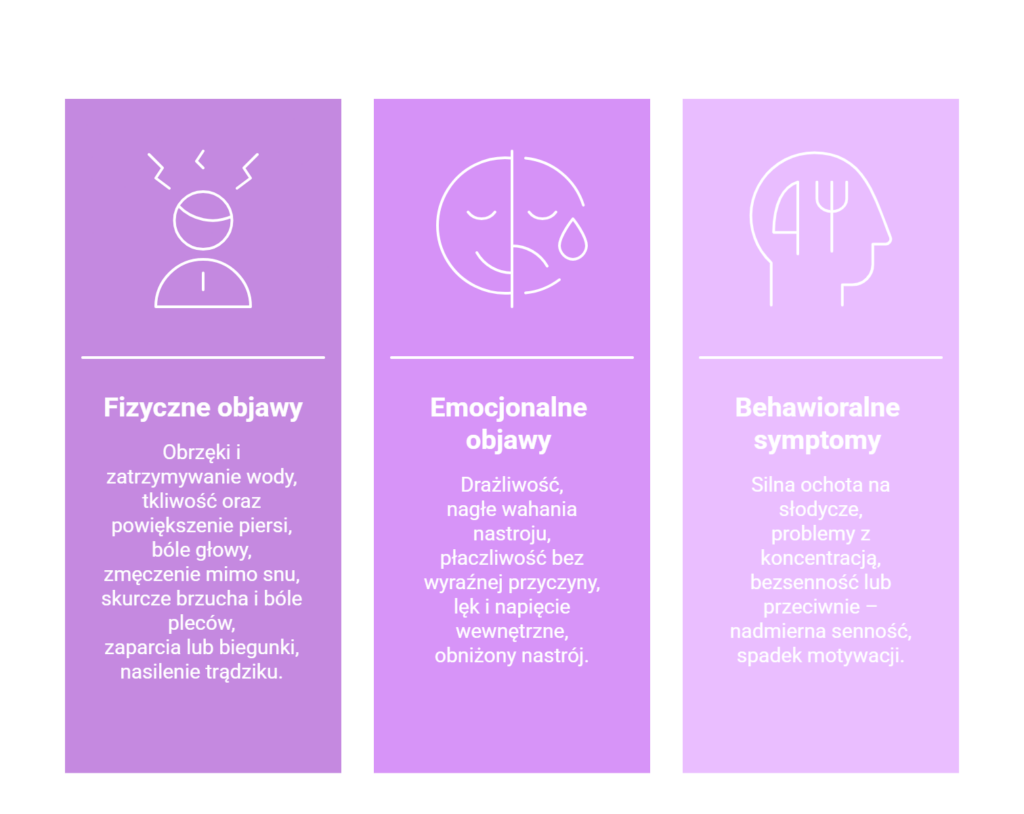
More than 150 possible PMS symptoms have been described, although most women experience a few that repeat. They can be divided into three groups.
What distinguishes PMS is the combination of physical and emotional symptoms at the same point in the cycle. If every month, 5 days before your period, irritability + breast tenderness shows up – that’s a classic pattern.
Premenstrual tension – symptoms. How is it different from ordinary feeling unwell?
Premenstrual tension is simply another name for PMS. The same mechanism. The same symptoms. They appear in the luteal phase, that is, after ovulation. The most important difference? Cyclicity. It’s not random. It’s a recurring pattern that returns each month at a similar time.
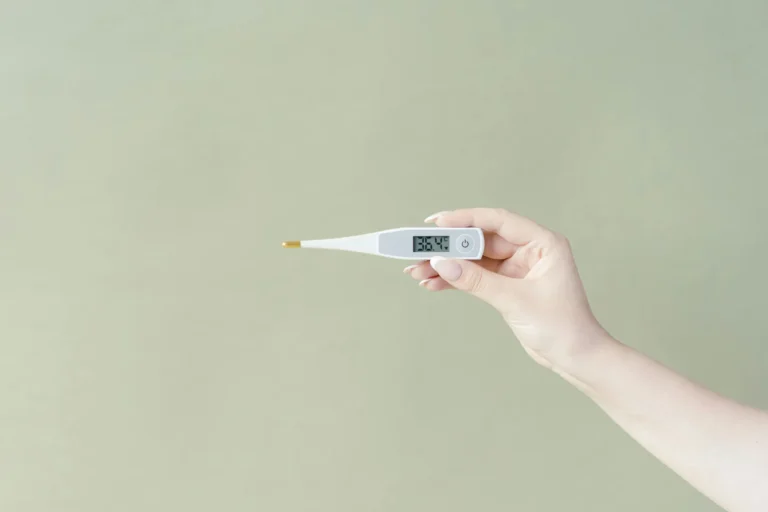
When PMS? After ovulation. In the second half of the cycle. At that time,body temperature naturally rises by about 0.2–0.5°C. This is a signal that the luteal phase has begun. And this is exactly where many women start to understand what’s going on in their cycle.
If you measure yourbasal body temperature, you can see the day of ovulation. And then it’s easier to predict when premenstrual tension will appear. If the temperature stays higher for several days – you’re in the phase when PMS can develop. Without this knowledge, it’s easy to confuse PMS with:
- chronic stress,
- the onset of depression,
- thyroid problems,
- exhaustion.
Cyclicity is key. If symptoms disappear after your period and return in the same part of the cycle – it’s most likely PMS. Tracking your cycle gives you something very concrete. Peace of mind. And the feeling thatyour body works according to its own logic, not randomly.
Notice that your symptoms appear very early or the phase after ovulation seems unusually short? Read our post aboutwhat a short luteal phase is and how it can affect your cycle and how you feel before your period.
How to recognize PMS symptoms before your period and stop guessing every month?
The best way to identify PMS is totrack observations for at least 2–3 cycles. You can:
- note symptoms in a calendar,
- rate their intensity on a scale of 1–10,
- record the cycle day on which they appear.
Even more precision comes fromcombining observations with temperature measurement. The MY OVU ovulation thermometer isa flexible ring made of medical-grade silicone, which is placed in the vagina overnight andautomatically measures basal body temperaturewith an accuracy of 0.01°C.

You don’t have to get up at a fixed time or remember a morning reading. The device monitors your temperature throughout the night, and you sync the data with the app.
Why is this important for PMS? Because when you see a clear temperature rise in the app, you can confirm the moment of ovulation and determine the start of the luteal phase. And that means you can:
- predict when PMS symptoms may appear,
- better understand whether the symptoms fit the PMS pattern or require further observation,
- check whether the luteal phase isn’t too short.
MY OVU is an over‑the‑counter medical device used to predict and monitor ovulation. If you’re looking for a way to stop wondering every month “is this PMS already?”, tracking your temperature gives a clear answerinstead of guesswork.
How many days before your period is PMS the strongest, and when is it worth consulting a doctor?
The strongest PMS symptoms usually appear 3–5 days before your period. That’s the moment. Hormones drop sharply. The body feels it. And the symptoms become more pronounced. Sometimes really intense.
Then you might think: this isn’t just mild discomfort anymore. However, if the complaints start to go beyond typical PMS symptoms, it’s good to pause for a moment. And take a closer look.
Warning signs include:
- symptoms that prevent normal functioning,
- severe depressive states or panic attacks,
- suicidal ideation,
- very painful periods.
In such cases it may be PMDD. This is a more severe form of the premenstrual syndrome. Symptoms are then intense. And they genuinely affect daily life – work, relationships, sleep. The risk of PMS increases, among others, with:
- family history,
- high stress,
- painful periods.
If PMS symptoms appear irregularly – sometimes earlier, sometimes later – or do not subside after bleeding begins, that’s a signal to do basic hormonal tests (e.g., progesterone, TSH, prolactin). Diagnostics can help determine whether it’s really PMS or something else is disrupting the body’s balance.
If PMS symptoms significantly hinder daily functioning, check out our guide how to cope with premenstrual syndrome. You’ll find specific, practical ways to help ease tension and regain balance in the second half of the cycle.
What’s worth remembering about PMS – key information in one place
If after reading the entire text you feel a bit overwhelmed – don’t worry. Below are the most important things that are really worth remembering.
- PMS most often starts 5–11 days before your period, although for some women it may appear even 7–14 days earlier.
- Symptoms develop after ovulation, in the luteal phase, when progesterone naturally rises.
- The greatest severity of PMS usually falls 3–5 days before your period.
- Cyclicity is key – symptoms should recur at a similar time for at least two cycles.
- Tracking your post‑ovulation temperature helps predict when symptoms may appear.
- If the complaints are very severe, irregular, or do not subside after your period – it’s worth consulting a doctor.
Understanding these few points lets you approach PMS more calmly. Because when you see a pattern, you stop guessing – and start consciously observing your body.